· Dash Checkout · order-limits · 8 min read
How to Stop Scalpers from Clearing Out Your Trading Card Shop: A Complete Guide to Purchase Limits on Shopify
Trading card retailers are losing inventory to scalpers within minutes of restocking. Here is how to enforce real per-customer purchase limits that actually work on Shopify.

A reseller walks into your store — digitally speaking — and buys every Prismatic Evolutions ETB you just restocked. Twenty minutes later, those same boxes are listed on eBay at triple the price. Your actual customers, the collectors who’ve been waiting weeks for restock, get nothing.
This isn’t hypothetical. It’s happening to trading card shops every single day.
Pokémon TCG products at MSRP are flipping for 200-300% markups. The $50 Elite Trainer Box hits $150 on the secondary market before most collectors even know it’s back in stock. Scalpers use bots, multiple accounts, and coordinated buying to clear inventory in minutes.
The damage goes beyond lost sales. Collectors lose trust in your shop. They stop checking your site because they assume everything’s already gone. The community you’re trying to serve gets priced out of the hobby entirely.
This guide covers exactly how to stop it — what Shopify gives you natively (not much), where it falls short, and how to implement real per-customer purchase limits that track across orders and actually prevent bulk buying.
About this guide: This article is written by Dash Checkout, which makes the DC Order Limits app for Shopify. We built our Customer Purchase Limits feature specifically to solve this problem. This guide includes honest coverage of Shopify’s native options and their limitations.
The scalper problem in trading cards is getting worse
Pokemon card values have surged in recent years, driven largely by speculative buying. That price gap between MSRP and market value creates a profit incentive that attracts organized scalping operations.
The pattern is consistent across TCG products:
- Pokémon TCG: Prismatic Evolutions, Crown Zenith, and chase sets sell out instantly
- One Piece TCG: OP-01 through OP-09 booster boxes flip for 2-3x retail
- Magic: The Gathering: Secret Lairs and collector boosters face the same pressure
- Warhammer/miniatures: Limited releases disappear to resellers
Major retailers have responded with strict limits. Walmart caps Pokémon TCG at 5 items per customer. Target limits some stores to 1 per person. GameStop enforces 2 items per account with managers sometimes dropping to 1 on hot releases. The Pokémon Center itself limits premium items to 1 per customer, per order, per account, per credit card, per person, AND per household.
Japanese retailers have gotten creative — Bic Camera requires customers to pass a 15-question Pokémon quiz before purchasing. Some stores remove packaging at point of sale to undermine resale value. Japan is even implementing government ID verification for priority purchases starting August 2026.
If billion-dollar retailers are implementing purchase limits, your Shopify store needs them too.
What Shopify does natively (and why it’s not enough)
Shopify offers one built-in option: add-to-cart limits. You can find this in Settings > Checkout > “Add-to-cart limit” and set a maximum quantity per item.
Here’s the problem: it’s a per-order limit, not a per-customer limit.
A scalper can add 2 units to their cart, check out, then immediately return and buy 2 more. Repeat until your inventory is gone. The limit resets with every completed order.
The bypass methods are well-documented
Shopify Community forums are full of merchants discovering these limitations the hard way:
- Direct checkout access: Customers can disable JavaScript and navigate directly to
/checkout, bypassing any cart-side restrictions - API manipulation: Direct POST requests to
/cart/update.jsbypass front-end quantity controls - Cart permalinks: Anyone can construct a URL that adds any quantity at any time
- Multiple accounts: Nothing stops a scalper from creating new accounts with different emails
The Shopify Community has threads going back years asking for true per-customer limits. Merchants have been promised feature requests would be submitted, but there’s been no native solution as of 2026.
Many merchants discover that basic inventory protection features they assumed were included actually require third-party apps.
What about discount code limits?
Shopify lets you limit discount codes to one use per customer. But this doesn’t help with purchase quantity limits — it only prevents discount abuse, not bulk buying.
What about Shopify Plus?
If you’re on Shopify Plus ($2,300+/month), you can use the Cart and Checkout Validation Function API to build custom server-side validation. This does work, but it requires developer resources to implement and maintain. For most trading card shops, this isn’t practical.
What actually works: per-customer purchase limits that track across orders
The solution is purchase limits that:
- Track by customer, not by cart — Remember what each customer has already purchased
- Persist across orders — Don’t reset after checkout
- Enforce at checkout validation — Block the order server-side, not just in the cart UI
- Handle guest checkout — Track by email address when customers aren’t logged in
This is exactly what Customer Purchase Limits in DC Order Limits does.
How to set up purchase limits for your trading card shop
Here’s a step-by-step approach for TCG retailers:
Step 1: Decide on your limit structure
Most trading card shops use one of these approaches:
| Strategy | Example | Best for |
|---|---|---|
| Per-product limits | 2 units of any specific SKU | Individual chase products |
| Per-collection limits | 4 total items from “New Releases” | Entire product lines |
| Lifetime limits | 1 ever per customer | Extremely limited releases |
| Time-based limits | 2 per week | Ongoing restocks |
For hot releases like Prismatic Evolutions, most shops start with 2 per customer per product with lifetime tracking. This prevents bulk buying while still letting collectors pick up a sealed copy and one to open.
Step 2: Set up customer purchase tracking
In DC Order Limits, navigate to Customer Purchase Limits and create a new rule:
- Select your products or collection — Choose the specific TCG products or create a “Limited Releases” collection
- Set the quantity limit — Start with 2 per customer
- Choose the time window — “Lifetime” for drops, or “Weekly/Monthly” for ongoing inventory
- Enable purchase history tracking — This is what makes limits persist across orders
The key setting: “Track purchase history” must be enabled. Without this, you’re just doing per-cart limits like Shopify’s native feature.
For detailed setup instructions, see our help docs:
- Customer Purchase Limits overview
- How to set customer purchase limits on Shopify
- Lifetime purchase limits
Step 3: Handle guest checkout
Scalpers often use guest checkout to avoid account-based tracking. DC Order Limits tracks purchases by email address for guests, so limits still apply even without a customer account.
For maximum protection, consider requiring login for limited products. This creates friction, but it also:
- Enables more accurate tracking
- Builds your customer database
- Lets you identify repeat limit violations
You can set this per-rule, so regular products allow guest checkout while limited releases require accounts.
Step 4: Consider different limits for different customers
Not all customers are equal. You might want:
- Higher limits for verified collectors — Customers with purchase history or loyalty program members
- Lower limits for new accounts — First-time buyers get 1 per product, established customers get 2
- Wholesale allocations — Separate limits for your B2B customers
DC Order Limits supports different limits based on Shopify customer tags. Tag your VIP collectors and set up rules that only apply to (or exclude) specific tags.
Step 5: Automate with Shopify Flow
For shops with complex needs, Shopify Flow integration enables automation:
- Reset limits after a time period — Automatically refresh allocations monthly
- Tag customers after purchase — Mark buyers of limited products for future reference
- Trigger notifications — Alert yourself when someone hits a limit repeatedly
See the Shopify Flow help docs for setup guides.
Best practices for TCG retailers
Based on what we’ve seen from trading card shops using DC Order Limits:
Be transparent about limits
Put your purchase limit policy on your product pages and in your FAQ. Legitimate collectors appreciate knowing the rules upfront. Something like:
“Per-Account Purchase Limits: To ensure more collectors get access to limited products, purchases are limited to 2 per customer. This limit is tracked across all orders.”
This messaging actually builds trust. It signals that you’re protecting the community, not just trying to maximize per-order revenue.
Start strict, then loosen if needed
It’s easier to increase limits than to deal with the fallout of scalped inventory. Start with 1-2 per customer on hot releases. If product sits longer than expected, you can always raise the limit.
Monitor for limit violations
Watch for patterns that suggest scalping attempts:
- Multiple accounts from the same IP or address
- Repeated limit blocks from the same email domain
- Bulk orders immediately after limit resets
DC Order Limits logs blocked attempts, so you can see who’s testing your limits.
Consider time-based limits for restocks
If you restock popular products weekly, a “per week” limit works better than lifetime limits. Collectors can buy on each restock, but can’t clear you out in one session.
Combine with other anti-scalping measures
Purchase limits are one layer. Also consider:
- CAPTCHA at checkout — Slows down bots
- Delayed inventory updates — Don’t announce exact restock times publicly
- Local pickup priority — Offer first access to customers who pick up in-store
- Community verification — Some shops require social media verification or community membership
What happens when someone hits the limit?
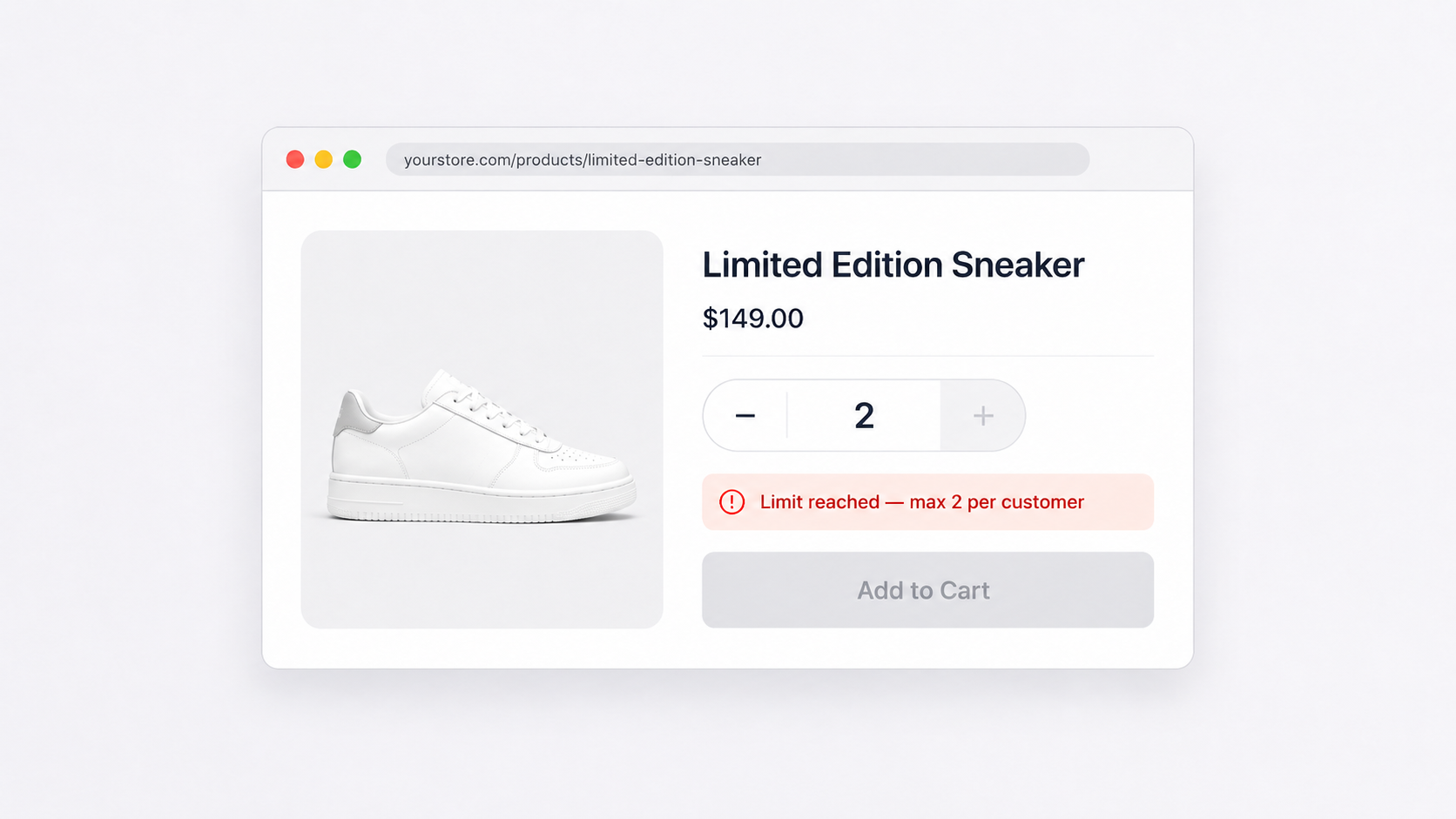
When a customer tries to exceed their purchase limit, DC Order Limits blocks the checkout with a clear message explaining why. The order doesn’t go through — this is server-side validation, not just a cart warning that can be bypassed.
You can customize the error message to explain your policy and suggest alternatives (like signing up for restock notifications).
The bottom line
Shopify’s native cart limits reset after every order. That’s not a purchase limit — it’s a minor inconvenience that any determined scalper works around in seconds.
Real purchase limits need to:
- Track customer purchase history across all orders
- Persist over time (lifetime, weekly, monthly — your choice)
- Enforce at checkout where it can’t be bypassed
- Work for both logged-in customers and guest checkout
If you’re running a trading card shop and losing inventory to scalpers, Customer Purchase Limits solves this. Set up takes about 10 minutes, and your next restock actually reaches the collectors it’s meant for.
Your community is watching how you handle this. The shops that protect their customers from scalpers are the ones building real loyalty in the TCG space.
Install DC Order Limits from the Shopify App Store and set up your first purchase limit rule today.