· Dash Checkout · preorder · 10 min read
Preorders vs dropshipping: when each model works (and when it backfires)
Two ways to sell products you don't have in stock. One gives you control and customer loyalty. The other prioritizes speed and variety. Here's how to decide which fits your business.
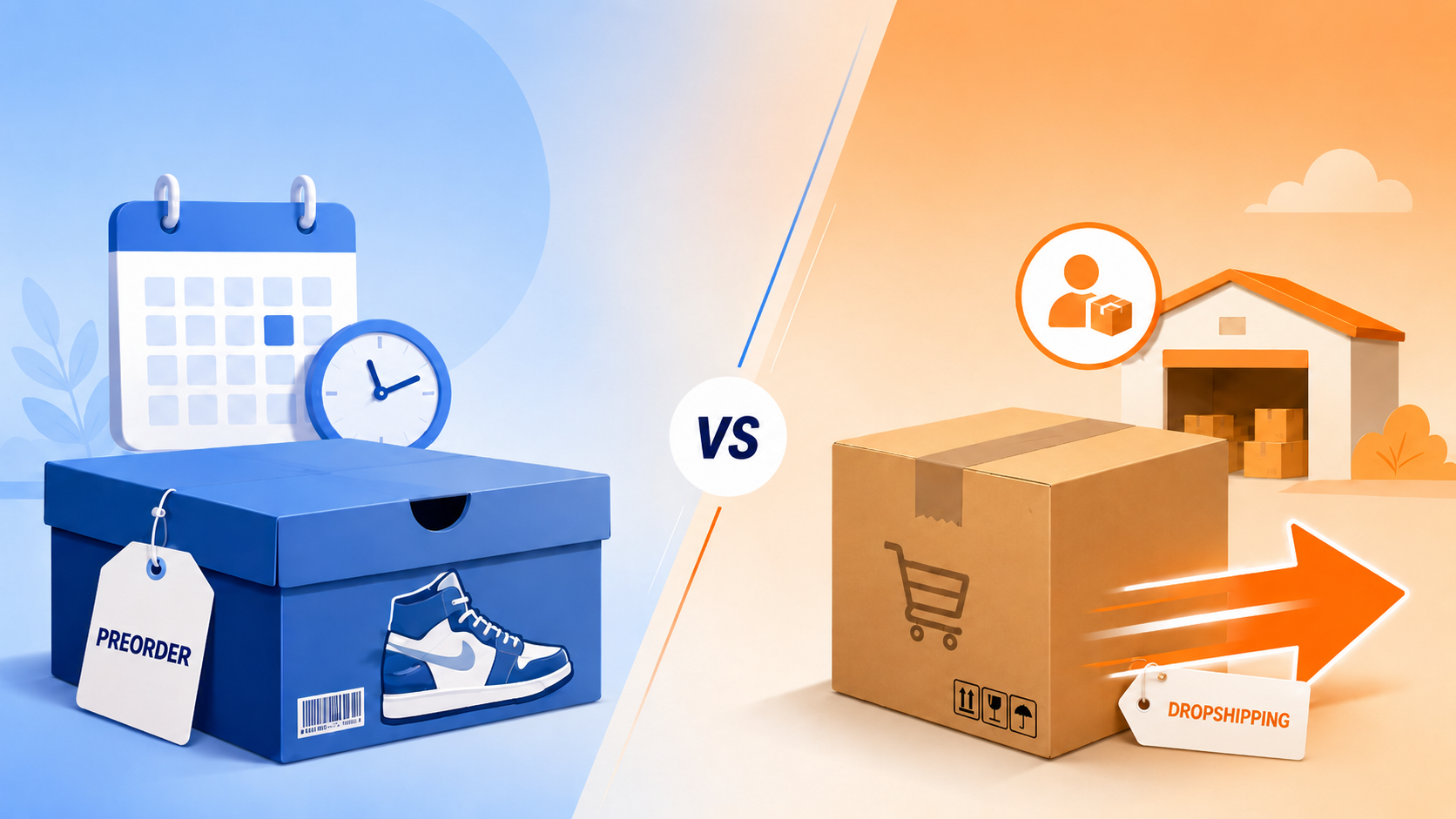
A sneaker brand takes preorders for their new collaboration and sells out 400 pairs in 48 hours. They ship six weeks later, and customers are thrilled because they secured a limited item.
A gadget store dropships trending phone cases from a supplier. Orders ship in 3-5 days, margins are thin, but they never touch inventory.
Both merchants are selling products they don’t have on hand. But their businesses look completely different. Their customer relationships, cash flow, and risk profiles have almost nothing in common.
Preorders and dropshipping both solve the same problem: you want to sell something without investing in inventory upfront. But they solve it in opposite ways, and choosing the wrong model for your situation creates problems that are hard to fix.
This guide breaks down when each approach works, when it backfires, and how to decide which fits your business.
What preorders actually give you
When customers place a preorder, they’re committing to a product before it exists or ships. They pay now (or put down a deposit), and you deliver later. This dynamic creates advantages that dropshipping can’t match.
You know demand before you commit to production. A ceramics brand considering a new mug design runs preorders for two weeks. They get 340 orders. Now they know exactly how many to produce. No overstock, no wasted materials, no guessing.
Compare this to ordering 500 units based on gut feeling and hoping they sell.
Cash comes in before expenses go out. A jewelry designer takes 200 preorders at $85 each. That’s $17,000 in revenue before she pays for materials. She uses that money to fund production. No loans, no credit card debt, no risk.
This matters especially for small businesses without capital reserves. Preorders turn customers into investors.
Customers feel ownership before they receive the product. Waiting for something creates anticipation. A customer who preorders a limited-edition print tracks the shipping notification more eagerly than someone buying commodity products. They share it on social media. They tell friends.
You’re not just selling a product. You’re selling participation in something.
You control the experience end to end. When something goes wrong with a preorder, you fix it. When something goes wrong with dropshipping, you’re waiting on suppliers who don’t work for you.
What dropshipping actually gives you
Dropshipping flips the model. Suppliers hold inventory, handle shipping, and take on the risk of unsold products. You take orders and pass them along.
You can list products immediately with zero upfront investment. Want to test whether your audience buys fitness equipment? List 50 products from a supplier catalog. See what sells. Stop listing what doesn’t. No warehouse. No inventory management. No minimum orders.
You can offer enormous variety. A gift shop can offer thousands of SKUs without storing anything. A niche store can test adjacent product categories without commitment.
Your risk per product is nearly zero. If something doesn’t sell, you lose nothing except the time spent listing it. No unsold inventory sitting in a warehouse costing you storage fees.
Scaling means adding products, not infrastructure. Going from 50 products to 500 doesn’t require a bigger warehouse, more staff, or more capital. You just list more items.
When preorders work
Preorders fit specific situations. They’re not a replacement for regular inventory management. They’re a tool for particular business problems.
New product launches. You’re releasing something that doesn’t exist yet. Preorders validate demand and fund production. A skincare brand launching a new serum takes 500 preorders before manufacturing the first batch. They know the product will sell because it already has.
Limited releases and collaborations. Scarcity is the point. A coffee roaster partners with a local artist on limited-edition packaging. They take preorders for two weeks, cap at 200 bags, and close orders. Customers who got in feel exclusive. Customers who missed out watch for the next drop.
Restocking popular items. A candle maker’s bestseller sells out. Instead of losing those customers, she opens preorders for the next batch. Customers secure their order instead of checking back daily or buying from a competitor.
Custom or made-to-order products. A furniture maker builds to order. Every sale is effectively a preorder. The business model is preorders.
Products with long lead times. Importing containers from overseas? Preorders bridge the gap between ordering from suppliers and having inventory to sell.
When preorders backfire
Preorders can damage your brand faster than almost any other business mistake when mismanaged.
Overselling. You take 800 preorders for a product you can only get 300 units of. Now you’re refunding 500 people and explaining why they’re not getting what they paid for. Some will never buy from you again. Some will leave one-star reviews. Some will dispute the charges.
If you’re taking preorders, cap them. Set a limit based on your actual supply. When you hit the cap, close preorders.
Vague timelines. “Ships soon” is not a delivery estimate. Customers need specific dates. “Ships week of March 15” sets expectations. “Ships when ready” creates anxiety and support tickets.
If you don’t know when you can ship, you’re not ready to take preorders.
Repeated delays. One delay is forgivable with good communication. Two delays make customers nervous. Three delays make customers angry. If your production timeline is uncertain, don’t take preorders yet.
Products that can’t live up to anticipation. Preorders build excitement. If the product disappoints, that disappointment hits harder because customers waited for it. A mediocre product sold normally is forgettable. A mediocre product sold via preorders feels like a broken promise.
When dropshipping works
Dropshipping fits different situations than preorders. It’s a testing and scaling tool, not a relationship-building tool.
Testing product-market fit. You have an audience but don’t know what they’ll buy. List dropshipped products. See what clicks. Use the data to decide what to stock or create yourself.
Low-margin, high-volume categories. Some categories don’t support the economics of preorders. Phone cases, generic accessories, basic supplies. Customers want them fast and cheap. Margins are tight. Dropshipping makes sense because there’s no room for the premium pricing that makes preorders worthwhile.
Complementary products. Your core business is handmade jewelry. You also sell cleaning supplies and storage boxes. Those complementary products don’t need your brand’s story. Dropship them.
Geographic expansion. You want to test a new market without committing to local inventory. Dropship to gauge demand before investing in fulfillment infrastructure.
When dropshipping backfires
Dropshipping has failure modes that are hard to recover from.
Quality is out of your control. Your supplier’s quality is your quality. When products arrive damaged, poorly made, or different from photos, customers blame you. You can refund them, but you can’t fix the experience. Multiple suppliers mean multiple quality standards. Consistency is hard.
Shipping times vary wildly. Some suppliers ship in three days. Some take three weeks. Customers don’t know they’re buying from different suppliers. They just know some orders arrive quickly and others don’t. That inconsistency damages trust.
Competition is trivial. If you can dropship a product, so can everyone else. The same item appears on dozens of stores. Competition becomes pure price competition. Margins shrink. The winner is whoever can afford the lowest profit per sale.
Customer service is reactive. When a dropshipped order goes wrong, you’re chasing suppliers for answers while customers wait. You don’t have the product to inspect. You don’t have tracking until the supplier provides it. You’re a middleman, and customers feel it.
Branding is nearly impossible. Dropshipped products arrive in generic packaging from addresses customers don’t recognize. There’s no unboxing experience. No brand reinforcement. No reason to come back to you instead of buying directly from the supplier next time.
The hybrid approach
Many successful merchants use both models for different parts of their business.
Core products via preorders, accessories via dropship. A gaming accessories company takes preorders for their custom controllers. They dropship generic cables, stands, and cases. The controllers build the brand. The accessories add revenue without distraction.
Premium via preorders, entry-level via dropship. A home goods store offers their signature line via preorders for committed customers. They also carry dropshipped basics for customers who aren’t ready to wait. The preorders are the business. The dropship items fill out the catalog.
Test via dropship, scale via preorders. See what sells as dropshipped products. When something takes off, develop your own version and sell it via preorders for better margins and brand control.
Making the decision
Ask yourself these questions.
Is your product differentiated? If customers can get essentially the same thing elsewhere, preorders don’t make sense. Why would they wait for something they can buy immediately from a competitor? Preorders work when you’re offering something customers can’t get anywhere else.
Do you have production control? Preorders require reliable timelines. If you’re depending on manufacturers or suppliers who miss deadlines, you’ll break promises to customers. Better to dropship than to take preorders you can’t fulfill.
What’s your margin? Preorders work with premium pricing. Customers pay for exclusivity and anticipation. Low-margin products can’t support the overhead of managing preorder campaigns, customer communication, and delayed fulfillment.
How do you want customers to feel? Preorder customers feel like insiders. They got access to something limited. They participated in a launch. Dropship customers feel like… they bought something. That’s fine for commodities. It’s not fine for brands built on community and loyalty.
Can you handle customer service proactively? Preorders require proactive communication. You need to update customers on production progress, shipping timelines, and any changes. If you can’t commit to that, stick to models where products ship immediately.
Getting preorders right
If preorders fit your business, execution matters. Done well, preorders build loyalty and generate capital. Done poorly, they generate refunds and negative reviews.
Set limits before you announce. Calculate your actual capacity. How many units can you produce or source? Set that as your preorder cap. When you hit the limit, close preorders automatically. This prevents overselling and creates urgency.
Be specific about dates. “Ships March 15-22” is better than “Ships mid-March” which is better than “Ships soon.” Give customers concrete expectations.
Communicate during the wait. Production update emails keep customers excited instead of anxious. A quick “your preorder is in production and on schedule” costs nothing and builds confidence.
Cap per-customer purchases. If you have limited supply, spread it across more customers. One or two units per customer ensures more people get access, prevents bulk buying, and creates more brand advocates.
Have a contingency for delays. If something goes wrong, how will you communicate? What will you offer? A discount on the next order? Priority access to future releases? Plan this before you need it.
Getting dropshipping right
If dropshipping fits your business, focus on minimizing its weaknesses.
Vet suppliers thoroughly. Order samples. Check shipping times. Test customer service. A cheap supplier with 20-day shipping and 15% defect rates will cost you more in refunds and lost customers than a reliable supplier at higher prices.
Set realistic shipping expectations. If your supplier ships in 7-14 days, say that. Customers can handle a wait if they know about it upfront. They can’t handle surprises.
Communicate like the product is yours. Even if you’re dropshipping, own the customer relationship. Provide tracking. Follow up after delivery. Handle complaints quickly. The product might come from a supplier, but the experience is yours.
Don’t compete solely on price. Find dropship products that fit a niche. Curate them thoughtfully. Provide content and context that adds value. Otherwise you’re racing to the bottom with every other store listing the same items.
The bottom line
Preorders and dropshipping solve the same problem differently. Preorders trade speed for control. Dropshipping trades control for speed.
Neither is universally better. The right choice depends on what you’re selling, who you’re selling to, and what kind of business you want to build.
Brands built on limited releases, community, and premium products often thrive with preorders. Brands built on variety, convenience, and low prices often work better with dropshipping.
Many of the best merchants use both strategically, letting each model serve its purpose without pretending one can replace the other.